


CM Launches First Phase Of Chinar Plantation Drive In Shimla
Himachal Pradesh Chief Minister Sukhvinder Singh Sukhu kicks off the first phase of the strategic Chinar tree plantation campaign in Shimla.

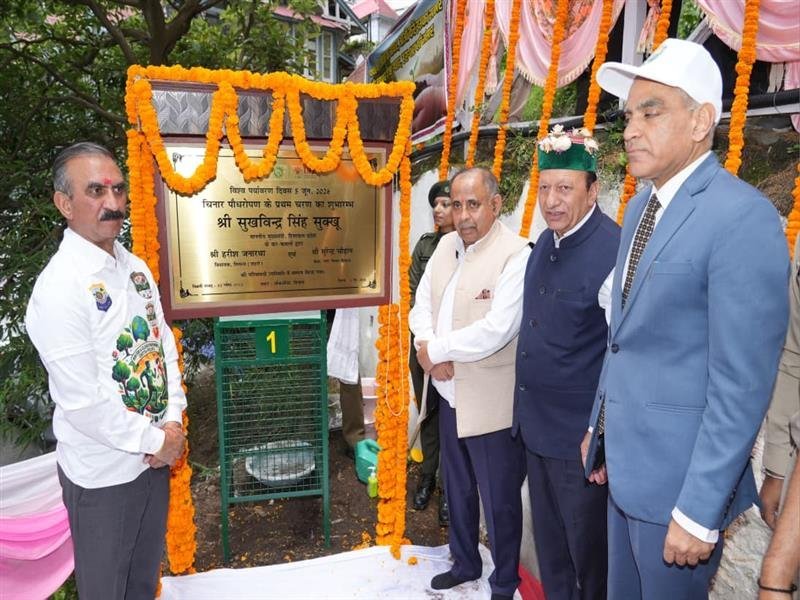
Shimla:Marking World Environment Day, Himachal Pradesh Chief Minister Thakur Sukhvinder Singh Sukhu officially launched the first phase of a dedicated Chinar plantation drive from his official residence, Oak Over. The targeted environmental campaign aims to dramatically enhance the region's green canopy while cultivating robust public participation in preservation initiatives.
The majestic Chinar tree (Platanus orientalis), widely celebrated for its dense shade and deep historical and ecological footprint, is uniquely suited to Shimla’s specific high-altitude climate. During the rollout, Chief Minister Sukhu underlined that the younger generation holds the key to long-term environmental stewardship, presenting native saplings to local school students and designated 'Children of the State.'
The administration intends to expand this drive across targeted high-hill zones identified meticulously by the state forest department. Alongside the plantation launch, the Chief Minister released four foundational forestry and eco-tourism publications, including Van Bodh, a field manual designed to equip frontline forest personnel with modern field tactics.
Another notable release, Environmental Management and Regulations authored by Principal Chief Conservator Dr. Sanjay Sood, alongside a specialized review of internationally funded JICA and KfW forestry projects, will serve as operational frameworks for researchers and policymakers. Addressing public gatherings at the Ridge later in the afternoon, Sukhu pointed out that Himachal Pradesh acts as the functional "Lungs of North India," providing ecological services worth roughly ₹90,000 crore annually to downriver states.
He emphasized that the state government has established an aggressive tree plantation benchmark covering 8,000 hectares of territory for the 2026-27 fiscal year. The master plan relies heavily on indigenous and fruit-bearing flora to protect regional biodiversity, restore unstable landscapes, and systematically upgrade the state's total forest cover from 29.5 percent to a target of 32 percent by 2030.
What's Your Reaction?
 Like
0
Like
0
 Dislike
0
Dislike
0
 Love
0
Love
0
 Funny
0
Funny
0
 Wow
0
Wow
0
 Sad
0
Sad
0
 Angry
0
Angry
0















Comments (0)