


I want everything in the village, but I don't want the village.
Dr. Priyanka Saurabh critiques modern society’s hypocritical relationship with rural India—eagerly consuming organic village produce and romanticizing traditional culture while abandoning the actual communities, infrastructure, and people that sustain them.
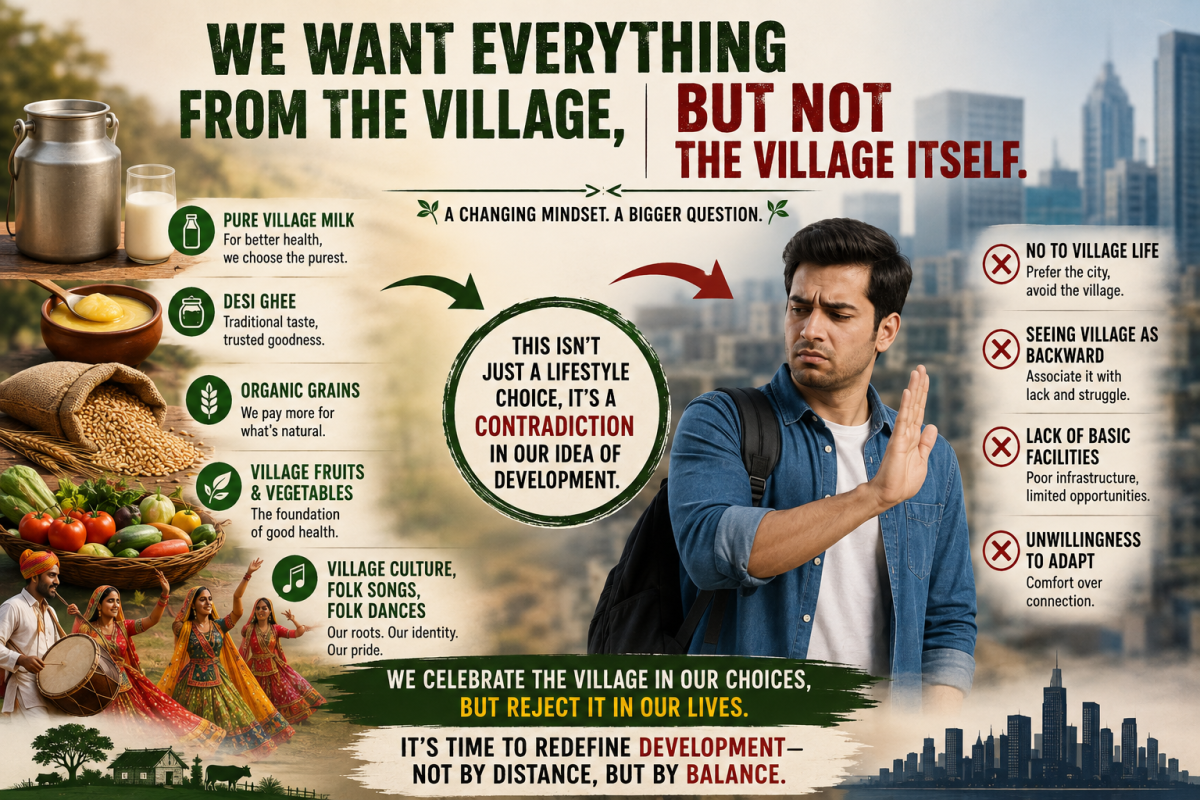
I want everything in the village, but I don't want the village.
- Dr. Priyanka Saurabh
"We want everything from the village, but not the village itself." This isn't a simple statement, but rather a fitting depiction of the changing mindset of modern Indian society. We talk about pure village milk, praise desi ghee, are willing to pay more to buy organic grains, consider village fruits and vegetables the foundation of health, and identify village culture, folk songs, folk dances, and traditional life as our identity. But when it comes to living in the village itself, most people want to distance themselves from it. This contradiction is not just a question of lifestyle, but also of our concept of development.
For centuries, India has been called a country of villages. Even today, a large population lives in rural areas. Our economy is founded on agriculture, and agriculture is impossible without villages. Yet, ironically, while village products are respected, villages themselves suffer neglect. We seek to take everything from villages, yet we fall short in providing them with the respect, facilities, and opportunities they deserve.
Today, there's a huge market for "organic" in cities. Village wheat, millet, mustard oil, local pulses, and fresh vegetables sell at high prices. People consider village honey, local jaggery, and coarse grains to be healthy. But the lives of the farmers who produce these products are often filled with struggles. The children of the same farmers whose hard work fills the plates of urban residents are forced to migrate to cities for better education and healthcare.
Rural life's greatest asset has been its social connections. The entire village stood together as one family, through joys and sorrows. Weddings, festivals, harvests, or times of crisis—every occasion symbolized togetherness. Today, in urban life, people seek this same sense of belonging. People living in large apartments don't even know their neighbors. Meanwhile, the village square, the shade of the peepal tree, and group conversations are slowly fading into memory. We praise that intimacy, but do nothing to preserve it.
The search for education and employment has accelerated the migration of youth from villages. This migration is not only economic but also cultural. Educated youth consider settling in cities a success. Returning to villages is seen as a symbol of backwardness. As a result, more elderly people, women, and children remain in villages, while the energy of young people is being expended in cities. If quality education, modern healthcare, industry, and respectable employment were available in villages, a large number of people would choose to remain in their villages.
It's also true that villages face many challenges. Lack of basic amenities like education, health, transportation, internet, drinking water, sanitation, and employment is still evident in many areas. Problems like social evils, caste discrimination, and conservatism also persist. It's important to acknowledge these shortcomings, but the solution lies not in fleeing villages, but in improving them.
Today, when the entire world is grappling with an environmental crisis, the importance of villages increases even more. Clean air, open fields, trees, water sources, and a life in harmony with nature are the hallmarks of villages. In cities, people seek to experience nature by building artificial parks, whereas in villages, nature is a natural part of life. If we expand cities without preserving villages, future generations will only see natural life in books and pictures.
The COVID-19 pandemic also reminded us of the importance of villages. When economic activity in cities ground to a halt, millions of people returned to their villages. Villages provided them with shelter, food, and the opportunity to rebuild their lives. It became clear then that villages are not just geographical entities, but also society's strongest security system in times of crisis.
Today, the need is not just to create rural development plans, but to change the mindset of development. The need is not to turn villages into cities, but to integrate them with modern amenities while retaining their unique characteristics. Good roads, quality schools, digital connectivity, modern hospitals, agriculture-based industries, skill development, and local employment—these are the true foundations of rural development. If opportunities exist in villages, migration will naturally decrease.
We must also inculcate respect for villages in our education system. Children must understand that farming is not just a profession, but the foundation of the nation's food security. Farmers are not only food providers but also environmental protectors. Villages are not just places to live, but the very source of our civilization and culture.
The media and entertainment industry also play a significant role in this. Villages are often portrayed as either extremely backward or merely romanticized. The real village is different from both these images. It offers struggles and possibilities; it also offers tradition and the desire for change. Only a balanced portrayal can foster a positive perspective in society.
The government, society, and the private sector must work together to strengthen the rural economy. Villages can become self-reliant by promoting agriculture, animal husbandry, beekeeping, fisheries, cottage industries, rural tourism, and handicrafts. Digital technology and e-commerce can help rural products reach consumers directly. This will increase the income of farmers and rural entrepreneurs and create new employment opportunities in villages.
A village is defined not only by its farms but also by its culture. Respect for elders, collectivism, cooperation, sensitivity to nature, and simplicity—these values remain the village's greatest strengths even today. Modernity doesn't mean abandoning these values, but rather advancing them in step with the times. If we lose these values in the race for development, even economic prosperity will fail to bring us mental satisfaction.
Society must recognize that cities and villages are not competitors, but complementary. Cities are centers of industry, education, and services, while villages are the foundation of agriculture, culture, and natural resources. Only the balanced development of both can empower a nation. The dream of inclusive development cannot be achieved by developing cities alone and neglecting villages.
Today, it's time to look within and ask ourselves—do we truly love the village, or only its produce and amenities? If we want the village's food, milk, air, culture, folk songs, festivals, and a sense of belonging, then we need the village too. The mindset of considering the village merely a source of resources must change. Only if the villages survive will our culture, our agriculture, and our identity survive.
Real development will come when young people aren't forced to leave their villages, but instead find opportunities to live in them with dignity. When a farmer's son feels proud to farm, when a village girl has access to quality education and healthcare in her own area, and when modern technology and traditional knowledge coexist in the village square, then India will truly be self-reliant and prosperous.
Let's not just love the things of the village, but love the village itself. Because if the village survives, the fields will survive, if the fields survive, food will survive, if food survives, life will survive, and if life survives, our civilization will also be safe. The truth is—we need not just everything in the village, but the village itself.
(Dr. Priyanka Saurabh, PhD (Political Science), is a poet and social thinker.)
What's Your Reaction?
 Like
0
Like
0
 Dislike
0
Dislike
0
 Love
0
Love
0
 Funny
0
Funny
0
 Wow
0
Wow
0
 Sad
0
Sad
0
 Angry
0
Angry
0

UP PLUS
Journalist

Comments (0)